
Four Steps to Unstick a Stalled Deep Tech Deal
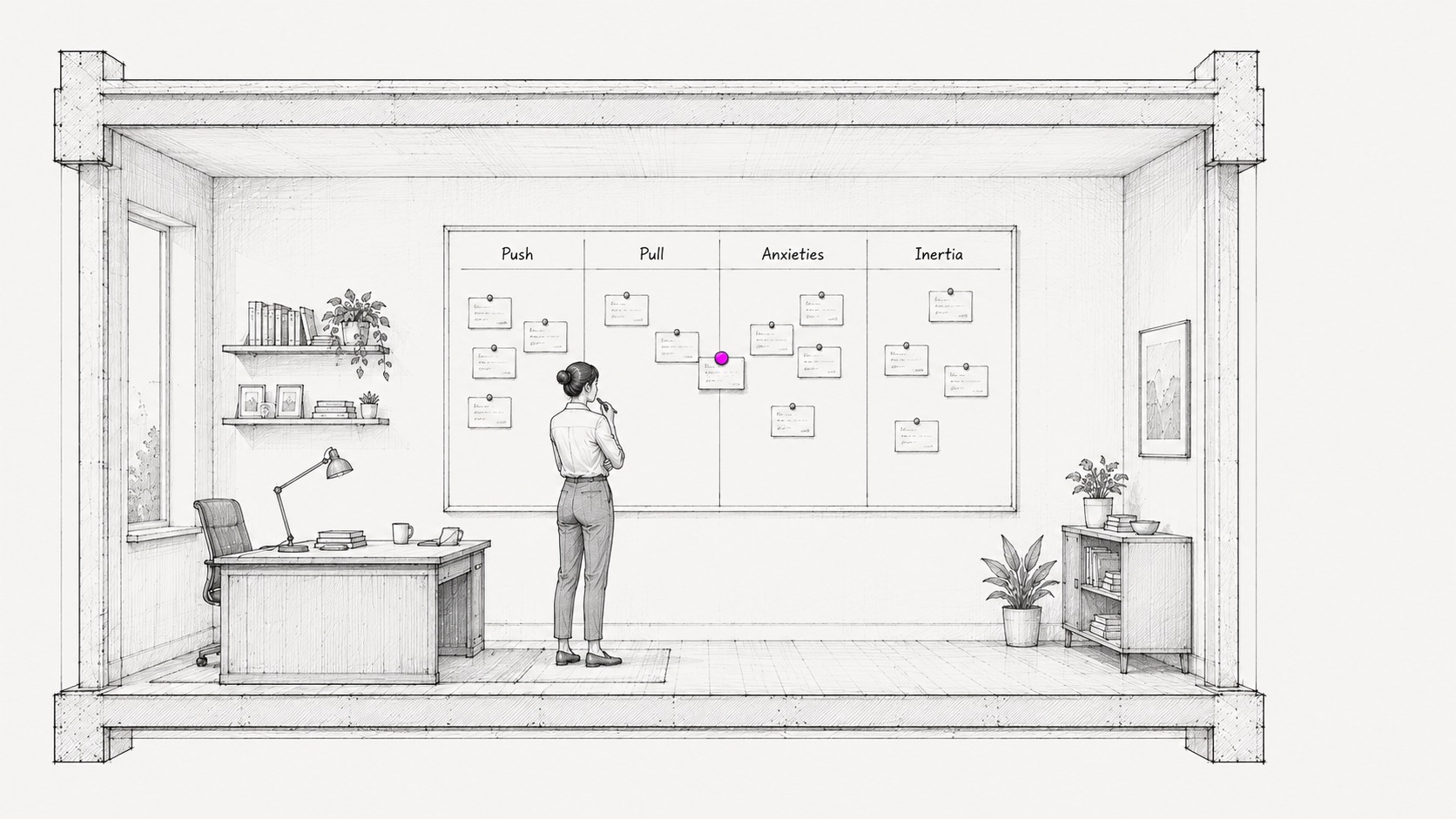
Once you can see Push, Pull, Anxieties, and Inertia in a deal, the question is what to do about each one. Here is the four-step diagnostic we run with founders at VECTOR.
Four Steps to Unstick a Stalled Deep Tech Deal
In the companion piece I covered the Four Forces of Progress - why deep tech buyers actually switch, and why Push and Pull alone are rarely enough to get a contract signed. This article picks up where that one ends. Now the practical question: how do you run the diagnostic on your own pipeline?
Most stalled deep tech deals look like Pull problems on the surface (“we just need to show them more value”) when they are actually Anxieties or Inertia problems underneath. The four steps below are designed to surface where the real friction sits, deal by deal.
Step 1: Identify Push Forces
Interview 10 to 15 customers. Ask: “What is the biggest frustration with your current solution, and what is it costing you?” Map the pain points. Look for patterns: cost, speed, scalability, compliance. The more intense the struggle, the stronger the push.
If buyers cannot answer the cost question with a number or a deadline, you are not looking at a real push. You are looking at curiosity, which is not the same thing.
Step 2: Build Pull Forces
Position your solution in terms of the progress your customer is trying to make, not the technology that makes it possible:
- Instead of “10x throughput on our custom silicon,” say “Your inference bill drops 60% with no model rewrites.”
- Instead of “Post-quantum encryption built in,” say “You will pass next year’s regulatory audit without rebuilding your auth stack.”
Pull must translate into a business outcome a senior buyer cares about. Technical capability alone never gets the deal across the line.
Step 3: Address Anxieties Head-On
Build a risk-reduction playbook: paid pilots, integration support, security documentation, case studies from comparable companies. Do not wait for objections. Surface and answer them in the pitch.
The anxieties that kill deals are usually the ones the buyer never voices - because raising them feels unprofessional, or because they don’t trust your answer yet. Surface them yourself. “Three things teams in your position usually worry about are X, Y, and Z. Here is how we handle each.”
Step 4: Break Inertia
Show how your solution integrates with existing workflows rather than replacing them. Provide migration paths, not disruptions. The goal is to reduce the perceived switching cost in your prospect’s mind before they raise it as a blocker.
Inertia is rarely about laziness. It is about sunk cost, internal politics, and the very real risk of a migration that disrupts a working team. Treat it with the seriousness it deserves.
What to Do This Week
- Pick your three most active deals. For each one, write down which of the four forces is doing the work and which is missing.
- For every deal where Push is unclear, schedule one customer conversation and ask: “What is this problem costing you in dollars, today?” If they cannot answer, the push is not real.
- For every deal where Anxieties are winning, write the three biggest worries the buyer has not voiced aloud. Then build a one-page answer for each.
- For every deal where Inertia is winning, draft a migration story that frames you as a layer on top of their current stack, not a rip-and-replace.
Most stalled deep tech deals look like Anxieties or Inertia problems being treated as Pull problems. Re-running the diagnosis usually unsticks at least one of them.
The Bottom Line
Deep tech companies that learn to balance these forces are the ones that drive meaningful adoption. It is not about selling innovation for innovation’s sake. It is about knowing the exact job your customer is trying to get done, and proving, unequivocally, that your product is the best tool for the task.
Features impress. Progress converts.
Want to run the diagnostic on a live deal with us? This is one of the first things we do with founders at VECTOR. Apply to work with us - or read the conceptual companion: Understanding Customer Progress Drives Product Adoption.
Related reading: