
How to Identify Your Customers' Burning Needs
Classic product-market fit happens when a burning need covers for imperfect execution. A 2x2 and five discovery questions to tell if your deep tech startup is addressing one.

Classic product-market fit is simple: address a burning need, and your flaws get forgiven. Rough product, missed deadlines, half-working demos - none of it matters when the need is real enough.
What Burning Needs Do
A burning need is one where solving it does at least one of three things:
- Removes a blocker standing in the way of your customer’s revenue growth
- Unlocks a product they’ve been wanting to build but couldn’t
- Takes a huge amount of technical risk off the table, letting them do something they couldn’t before
When you show up with a solution to that kind of need, deals move quickly. Customers find the budget. Procurement gets out of the way.
There’s a YC talk where someone describes it this way. Imagine your hair is on fire. Your desired outcome is to put out the fire. You need a fire extinguisher, a fire blanket, or a fire hose. But if all I have is a stinking bucket of putrid water, you’ll happily pay me for it.
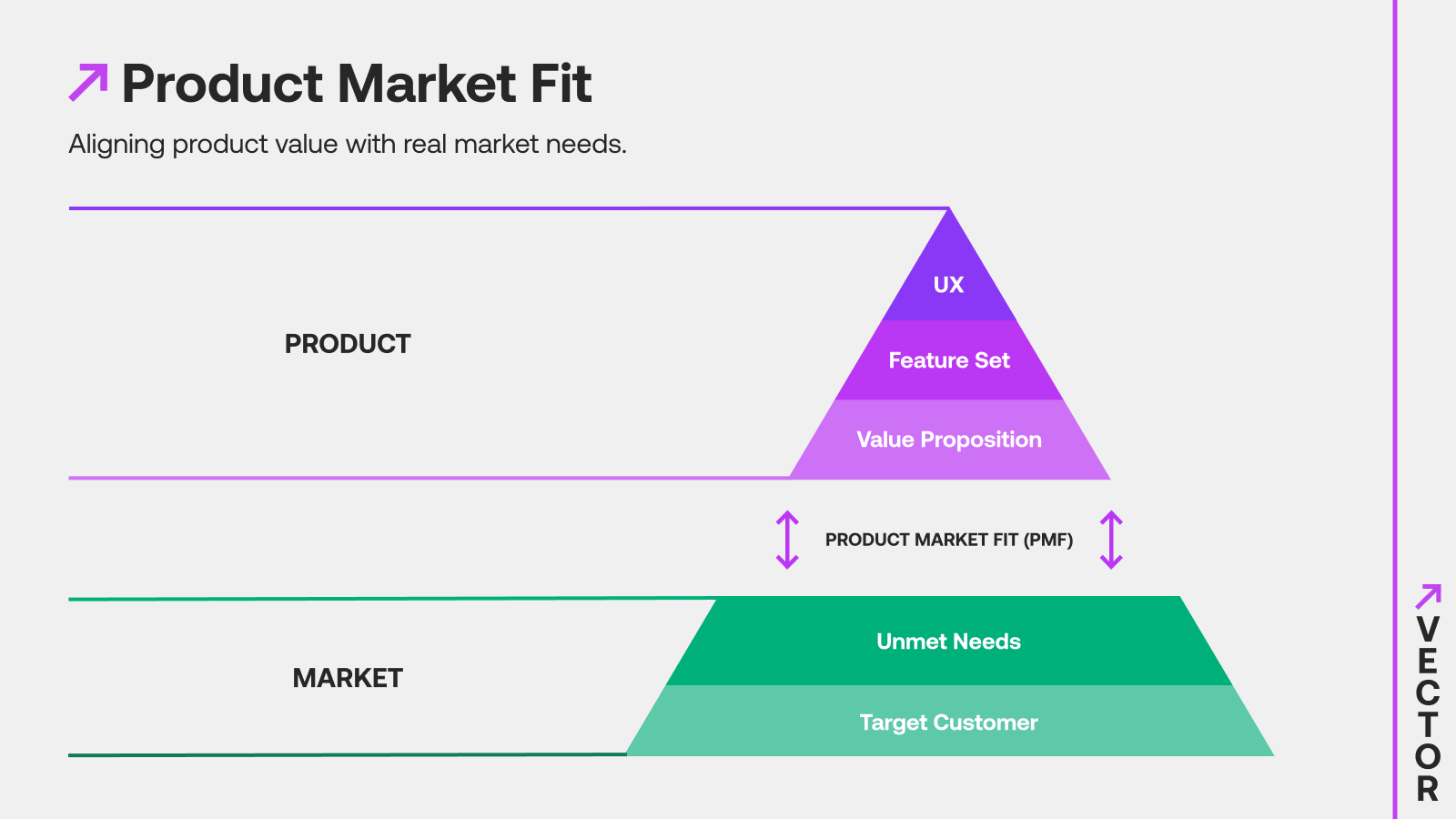
That’s what classic PMF looks like in diagram form. The interface is between your value proposition and your customer’s unmet need. When the unmet need is big enough, the value proposition is strong by default - which is why the layers above it, feature set and UX, can be narrower without killing the business. Most products that go on to succeed are technically rough at launch. The need is real enough that customers tolerate the rough edges.
Three Archetypes of Burning Need
Sequoia’s Arc team map this to three archetypes of product-market fit - three different flavours of burning need, each recognisable in different ways.
Hair on Fire. An urgent, obvious problem the customer is already trying to solve. The market is usually crowded, and the job is to be demonstrably better than what’s out there. Wiz hit $100M ARR in 18 months in cloud security by showing up with an agentless product that was meaningfully different from the incumbents.
Hard Fact. A pain the customer has accepted as unchangeable. They’ve stopped looking for solutions because they don’t believe there is one. The job here isn’t to beat competitors - it’s to prove that the pain is actually solvable. Square did this by convincing small businesses that the cash-only constraint they’d lived with forever could be broken with a smartphone.
Future Vision. A need the customer doesn’t yet know they have because the technology hasn’t existed long enough for them to articulate it. The job is to reshape their sense of what’s possible. ChatGPT became the fastest-adopted consumer product in history, despite nobody asking for conversational AI before it launched.
All three are burning needs. The difference is how visible the need is to the customer when you show up. In deep tech, most founders assume they’re in Hair on Fire territory when they’re actually in Hard Fact or Future Vision - and the go-to-market motion is completely different for each.
Most founders are also reluctant to admit they’re not addressing any of the three. So they spend more on product. Hire more salespeople. Raise more funding. The better move is almost always to go back to discovery and find a real need.
How to Spot One
The simplest rubric I’ve found for telling whether a need is burning is a 2x2.
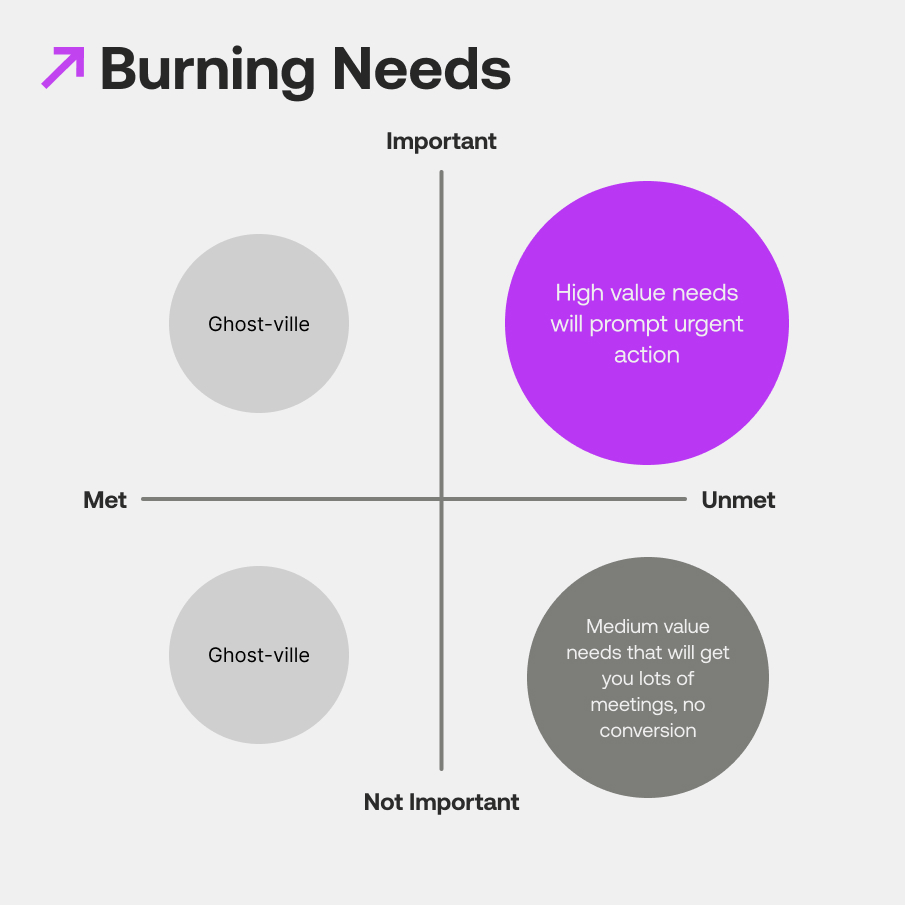
Plot each need you’re considering on it: importance against how well met. The top-right quadrant - important but unmet - is where burning needs live.
A well-differentiated product attacks that quadrant. And start with a focused segment, because you can’t find burning needs without one - narrowing your ICP is what accelerates sales.
Five Questions to Ask in Deep Tech
To find out whether the need you’re addressing lives in the top-right quadrant, run these five questions in your next discovery calls. Listen for specifics. Vague answers mean the need isn’t burning.
-
“Tell me about the last time you tried to solve this. What happened?” You’re listening for specific past behaviour. If they’ve tried and failed, the pain is real. If they’ve never tried, it hasn’t reached the top of their list.
-
“What does it cost you each quarter not to have this solved?” You’re listening for a specific number - in revenue, time, or risk. “It’s a real pain” isn’t an answer. “It costs us £200K a quarter in lost engineering time” is.
-
“What else have you tried, and why didn’t it work?” You’re listening for the existing solution landscape. Alternatives that almost work mean the need is partially met. Nothing that fits means you’re in the unmet quadrant.
-
“What changes in your business if this is solved next quarter?” You’re listening for downstream outcomes - faster time to market, higher revenue, reduced technical risk. If they can’t name a specific change, the need isn’t important.
-
“What’s stopping you from buying a solution today?” You’re listening for the gating constraint - budget approval, technical evaluation, integration concerns. “Nothing, we just haven’t got to it yet” means the need isn’t burning.
For more on how to run discovery calls that surface this kind of signal, see our buyer psychology reference.
Building things customers find interesting but never urgent? That’s the gap between an interesting need and a burning one - and it’s where most deep tech startups get stuck. At VECTOR, we help founders find the burning need and rebuild positioning around it. Apply to work with us - or read about the Four Forces of Progress that explain why even great products get stuck.