
Understanding Customer Progress Drives Product Adoption
Most deep tech founders lead with technology instead of customer progress. The Jobs to Be Done framework — and its Four Forces of Progress — helps you position your product around what customers actually hire you to do.

Most deep tech founders I work with at VECTOR make the same mistake: they lead with their technology instead of their customer’s progress.
They’ll say “Our quantum computing platform uses 99.9% accuracy” when they should be saying “You’re hitting computational limits that are blocking your R&D timeline — here’s how we solve that.”
The difference? One talks about features. The other talks about the job your customer is hiring you to do.
This is where the Jobs to Be Done (JTBD) framework comes in — covered in depth in our buyer psychology reference. I’ve applied this framework with 50+ deep tech companies at VECTOR. At its core, JTBD helps you shift from thinking about what your product does (supply-side thinking) to understanding what your customer wants to achieve (demand-side thinking). Customers “hire” your product to solve a problem or make progress — and understanding the forces that influence this decision is the difference between stalled deals and fast adoption.
The Four Forces of Progress
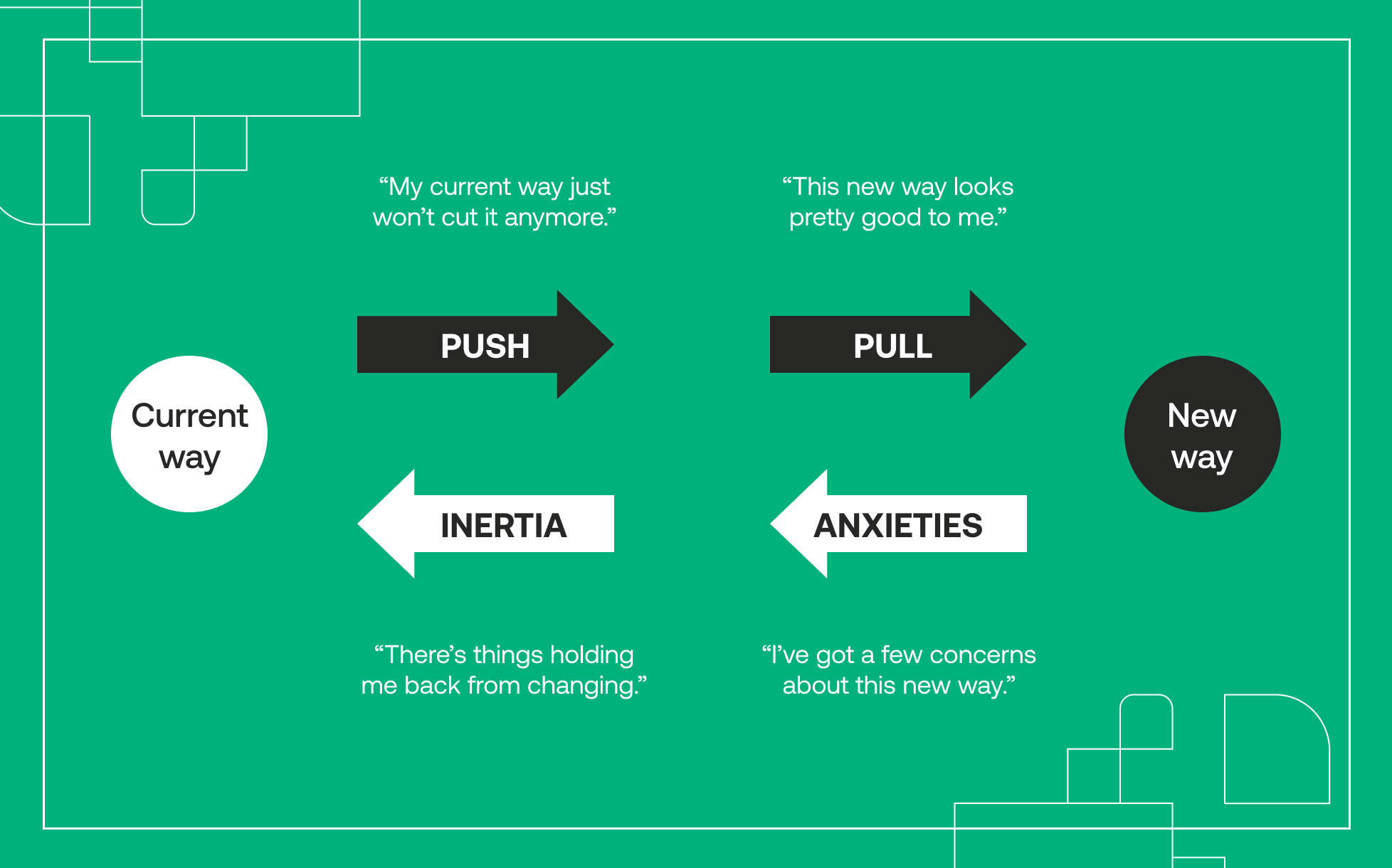
When a customer evaluates whether to adopt your solution, they’re subconsciously weighing four forces: the Push of the Situation, the Pull of the New Solution, Anxiety about the Change, and the Habit of the Present. The same forces apply when they decide whether to respond to your email or take your call.
1. Push of the Situation
This is the dissatisfaction your customer feels with their current solution. In deep tech, this could be a CTO dealing with a system that’s expensive to scale, or a process creating data bottlenecks in machine learning workflows. The more intense the struggle, the stronger the push to find an alternative.
2. Pull of the New Solution
The pull of your product lies in how clearly it solves that problem. Advanced edge computing that cuts latency. A more scalable platform for AI workloads. This pull must show not just incremental benefits, but a transformative leap. And critically — pull is rarely just technical. It’s about improvements in business metrics: revenue, profit, cost.
3. Anxiety of the New Solution
Anxiety is a deal-killer in deep tech adoption. Buyers worry about hidden costs, complex integrations, or learning curves for their teams. When you’re proposing cutting-edge innovations — new cryptography protocols, novel AI models — fears about security risks or operational disruptions are natural. Addressing these anxieties upfront is key to moving deals forward.
4. Habit of the Present
Inertia plays a huge role in keeping customers tied to their current solutions. They might use suboptimal tools, but if their workflows are already built around them, the hassle of change feels daunting. Think of a DevOps team reluctant to migrate from legacy infrastructure, despite knowing cloud-native architectures offer better flexibility.
Balancing the Forces for Adoption
For your product to gain traction, the combined Push and Pull forces must outweigh the Anxiety and Habit forces. When they don’t, you get the excitement-without-traction cycle that stalls so many deep tech companies.
Example: A pharmaceutical company is hitting computational limits — drug discovery simulations that used to take 3 months now take 9, blocking their pipeline (Push). Your quantum platform completes those same simulations in 2 weeks (Pull). But they hesitate (Anxiety) because quantum systems require specialised teams and downtime during migration. And they have £2M invested in existing HPC infrastructure (Habit) they can’t justify abandoning.
To close this deal, you don’t just need better technology. You need to reduce anxiety (implementation support, phased migration, security documentation) and reduce the perceived cost of habit (show integration, not replacement).
A Step-by-Step Framework
Step 1: Identify Push Forces
Interview 10–15 customers. Ask: “What’s the biggest frustration with your current solution?” Map the pain points. Look for patterns — cost, speed, scalability, compliance. The more intense the struggle, the stronger the push.
Step 2: Build Pull Forces
Position your solution in terms of the progress they seek, not your features:
- Instead of “99.9% accuracy,” say “Cut R&D timeline by 40%.”
- Instead of “advanced edge computing,” say “Reduce latency to enable real-time decision making.”
Pull must show transformative business outcomes, not technical capabilities.
Step 3: Address Anxiety Head-On
Create a risk-reduction playbook: free trials, integration support, security documentation, case studies from similar companies. Don’t wait for objections — surface and address them in your pitch.
Step 4: Break Habit Forces
Show how your solution integrates with existing workflows, not replaces them. Provide migration paths, not disruptions. The goal is to reduce the switching cost in your prospect’s mind before they raise it.
The Bottom Line
Deep tech companies that understand how to balance these forces are the ones that drive meaningful adoption. It’s not about selling innovation for innovation’s sake. It’s about knowing the exact job your customer is trying to get done — and proving, unequivocally, that your product is the best tool for the task.
Features impress. Progress converts.
Want to map your Four Forces? This is one of the first things we do with founders at VECTOR. Apply to work with us — or read about identifying your customers’ burning needs for the practical next step.