
From POC Failures to Predictable Sales: Using BANT and MEDDIC in Enterprise Sales
Your POCs aren't converting because you're qualifying on hope, not data. Here's how to use the MEDDIC framework with AI to score deals objectively - without hiring a £150K VP of Sales.

Six demos this month. Every prospect said “this is really impressive.” Your CTO got pulled into three technical deep-dives. One VP said “we definitely need this” on a call.
Zero moved to procurement.
If this sounds familiar, you’re stuck in pilot purgatory - and the problem isn’t your technology. It’s that you’re qualifying deals on hope, not data.
What It Looks Like When You Score a Real Deal
Before we talk frameworks, let me show you what objective deal qualification actually looks like. We ran our Deal Qualification Coach - an open-source AI skill that BANT and MEDDIC scores your sales calls - against a real (anonymised) customer call with one of our VECTOR founders. Here’s the output:
M (Metrics) - Score: 7/10
John Smith clearly references potential volume and scale (millions of devices), but doesn’t provide hard ROI figures or budget numbers.
For example, in two weeks, I’ll visit someone producing about 1.5 million pieces.
E (Economic Buyer) - Score: 8/10
John is a VP who speaks about management meetings and budget decisions with authority.
It’s really interesting to see people react and realize, ‘Now we have a real issue, and we have to start.‘
D (Decision Criteria) - Score: 7/10
Cost, time to market, and CRA compliance are the stated drivers, though exact technical criteria aren’t fully specified.
They’ll want to know about costs - this is a cost-critical matter.
D (Decision Process) - Score: 6/10
Near-term activities are visible (management meeting), but the formal procurement path isn’t mapped.
I have a management meeting… The primary question on the agenda is, ‘How do you handle key installation on devices during production?‘
I (Identify Pain) - Score: 9/10
The pain is clear and urgent: CRA compliance, provisioning at scale, cost sensitivity, and an 18-month product timeline. (For a deeper dive on pain identification, see identifying your customers’ burning needs.)
They have to start now; they have to make their considerations now - otherwise, they are lost.
C (Champion) - Score: 7/10
John wants to evangelise the solution but his internal influence needs confirmation.
Send me a two-slide summary that I can use in two weeks when I meet a customer. That would really help.
Coaching Notes
- Dig deeper on Decision Process - ask who signs off on budget and how compliance decisions are ratified.
- Quantify the cost of inaction - tie “being lost” to a dollar value or missed revenue.
- Expand the Champion role - give John the ROI messaging he needs to make the internal case.
- Elevate urgency - reinforce that compliance isn’t a long-term worry but an immediate threat to 2025 product launches.
This deal scored 44/60. The founder could see exactly where they were strong (Identify Pain at 9/10 - the customer is in genuine trouble) and where the gaps were (Decision Process at 6/10 - nobody has mapped how procurement actually works). That’s not a vibe check. That’s a map.
Here’s how to build one for every deal in your pipeline.
Why POCs Don’t Convert
When we talk to founders at VECTOR, we see three patterns behind stalled pilots:
- The need isn’t high priority. Your customer thinks it’s interesting but it’s not keeping anyone awake at night. No urgency, no budget, no deal.
- You’re solving a technical problem, not a business problem. Engineers love it, but nobody on the commercial side can connect it to revenue or risk.
- You’re being out-competed by internal projects. The customer agrees it’s a real problem - but they think they can build it themselves.
If you’re in the first camp, the honest answer is to go back to discovery. Find an unmet need that matters enough for someone to pay for it. If you’ve done that work - you’ve Mom Tested, you can point to 10 discovery interviews that confirm the problem - but still can’t move from POC to production, you have a qualification problem, not a product problem.
Two frameworks will fix it: BANT and MEDDIC.
BANT: Decide If a Deal is Real
BANT stands for Budget, Authority, Need, Timing. Use it early - from your very first interaction - to decide whether a prospect deserves your focus.
| Budget | Does the budget we’re asking for exist? Does a business case exist that connects the problem to meaningful value for the customer? |
| Authority | Does the person we’re talking to have the authority to get us into production? Who else needs to sign off? Are we talking to a P&L owner? |
| Need | Do we know what problem the customer thinks we’re solving? Does the customer believe this is an important need? |
| Timing | What deadlines exist on the customer’s side? Do they know key dates like go-live? |
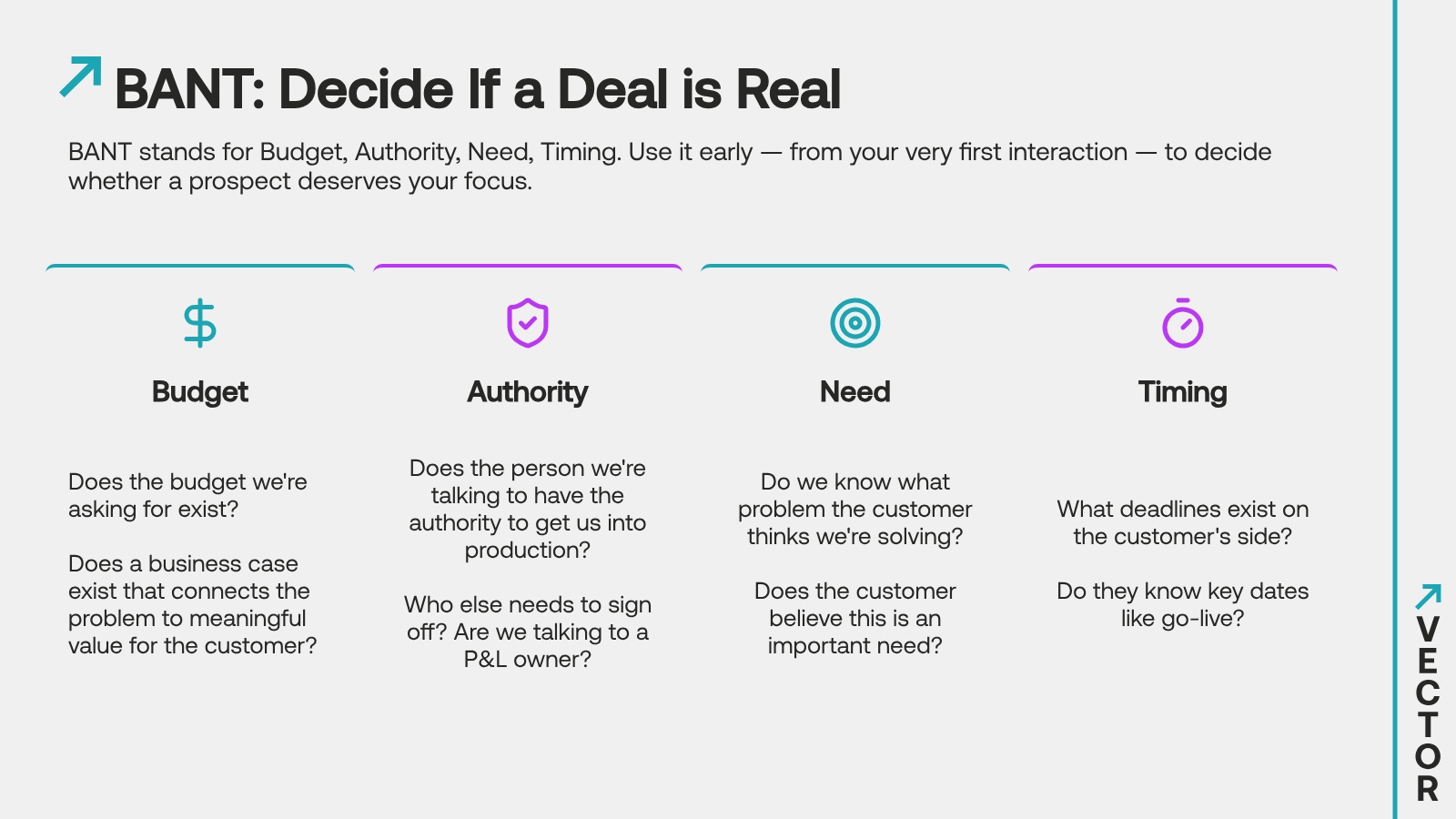
Score each deal on BANT from your first interaction. Only progress to sales qualified opportunity (SQO) when you have clear answers to all four.
We use BANT to qualify from MQL (looks like our ICP) to SQL (confirmed opportunity) and MEDDIC to qualify from SQL to SQO (a deal in the making).
MEDDIC: Your Map from Pilot to Production
At VECTOR we see too many high-potential startups struggle because the founders don’t make the link between their technology and meaningful value creation for the customer. This happens for a variety of reasons - getting stuck in the research lab, not pushing to talk to product and commercial teams, being overloaded with other priorities and failing to give each account the time it needs, failing to find a true champion and taking a passenger mindset rather than the driver mindset needed to close a deal.
MEDDIC is the solution - use it to hold yourself accountable, to build your map from pilot to a growing production contract.
MEDDIC stands for:
- Metrics: Quantifiable impact of your solution - in your customers’ words
- Economic Buyer: The person who can actually pay for your product
- Decision Criteria: The metrics or qualitative measures your customer will use to decide
- Decision Process: Steps to reach a decision - in your customers’ mind
- Identify Pain: The challenges your solution addresses for your customer
- Champion: Your internal advocate
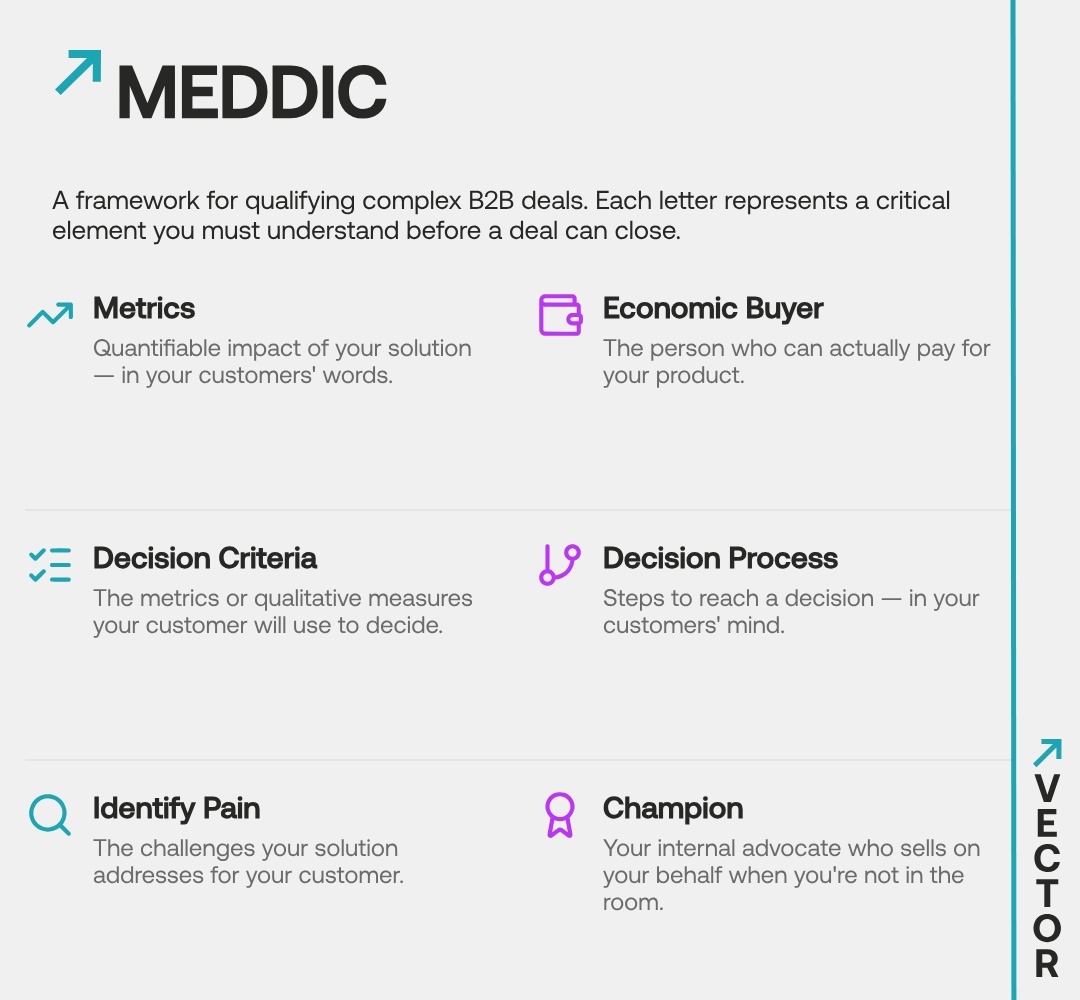
Notice the emphasis on your customers’ words. It’s common for founders to project their own opinion of the metrics and process the customer should follow.
You can’t change how your customer buys. Your job is to sell the way they want to buy. But don’t assume your customer knows how to buy your product - assume that you’ll need to help them get the deal across the line. You’re using MEDDIC as an accountability framework for your customers as much as for you.
How to Score Your Own Deals
Record your sales calls. Transcribe them. Then run them through our Deal Qualification Coach - it’s the same open-source skill we use with every founder in the VECTOR programme. It BANT qualifies your early-stage prospects and MEDDIC scores your active deals, backing every rating with a direct customer quote so you can see exactly where the signal is.
You can run it with Claude, ChatGPT, or any LLM that handles long transcripts.
What to Do Monday Morning
Pick your most important open deal. Record the next call (with permission), transcribe it, and run it through the Deal Qualification Coach.
Look at your Identify Pain score first. If it’s below 7, you’re selling technology, not solving a problem - and that deal will stall. If it’s above 7, look at Decision Process next. A high-pain, low-process deal is the most common pattern we see at VECTOR: the customer is desperate but nobody knows how to buy.
That’s your gap. Close it, and the deal moves.
At VECTOR, we work with high-potential deep tech founders to help them go from POC to £10M sales. Apply to work with us - or read why excitement doesn’t equal traction first.